Contribution to global observation networks
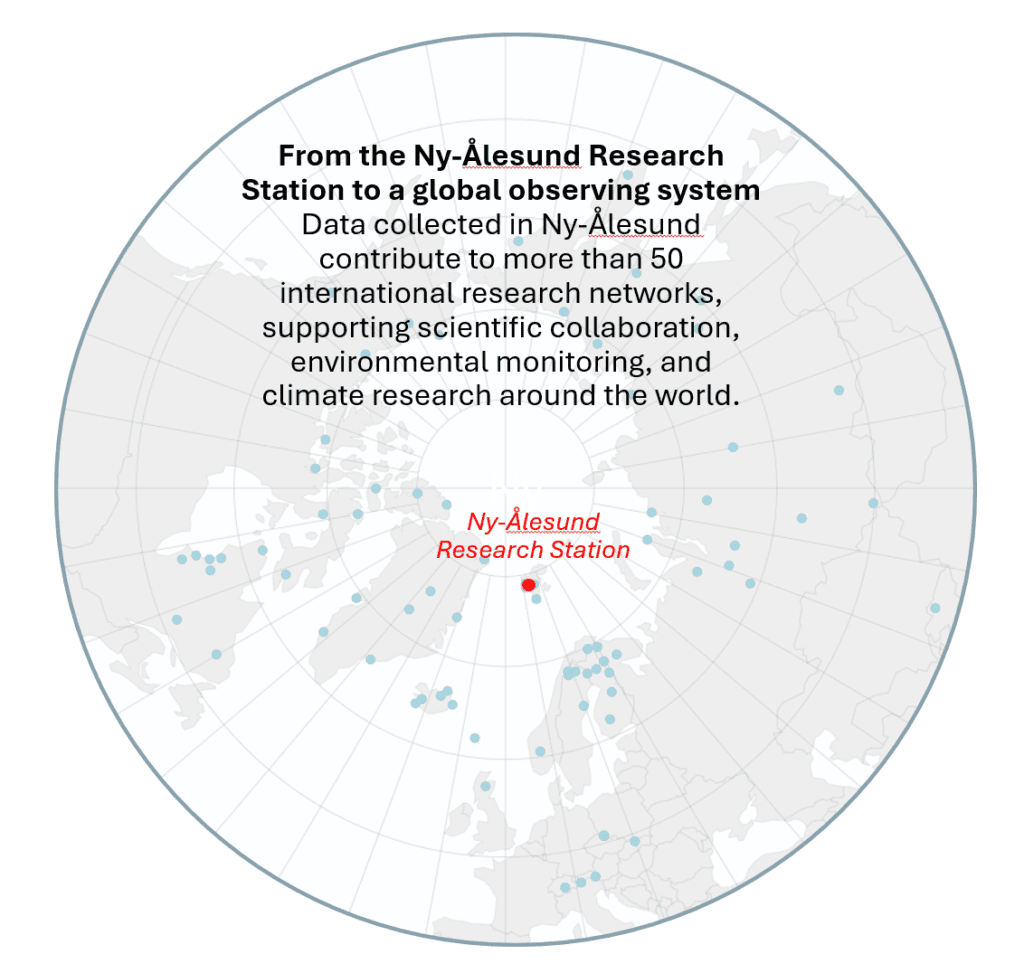
The long-term observations collected in Ny-Ålesund are among the research station’s most valuable scientific assets. Maintained over decades by the international research community, these observations provide unique insights into environmental and climate change in the Arctic.
Their value extends far beyond Svalbard. Through international observing networks, data collected in Ny-Ålesund are combined with observations from stations around the world, forming part of the foundation for climate assessments, environmental monitoring, forecasting services, and scientific research.
Today, the Ny-Ålesund research community contributes data to approximately 30 International Standardized Observing Networks (ISONs) and around 20 additional scientific networks, demonstrating the station’s important role in the global observation system.
Why long-term observations matter
Individual measurements are valuable, but their true significance emerges through continuity. Many environmental changes in the Arctic can only be detected through observations collected consistently over many years or even decades. Long-term datasets allow researchers to identify trends, distinguish natural variability from lasting change, and understand processes that cannot be observed through short-term studies.
Maintaining these observations requires dedicated infrastructure, stable observing conditions, and long-term scientific commitment. Continuity is particularly important for observations contributing to international observing networks, where changes in location, instrumentation, or measurement procedures can reduce the comparability of data and diminish the value of long-term records.
The long-term observations maintained in Ny-Ålesund therefore represent a shared scientific resource that supports research and environmental monitoring from the Arctic to the global scale.
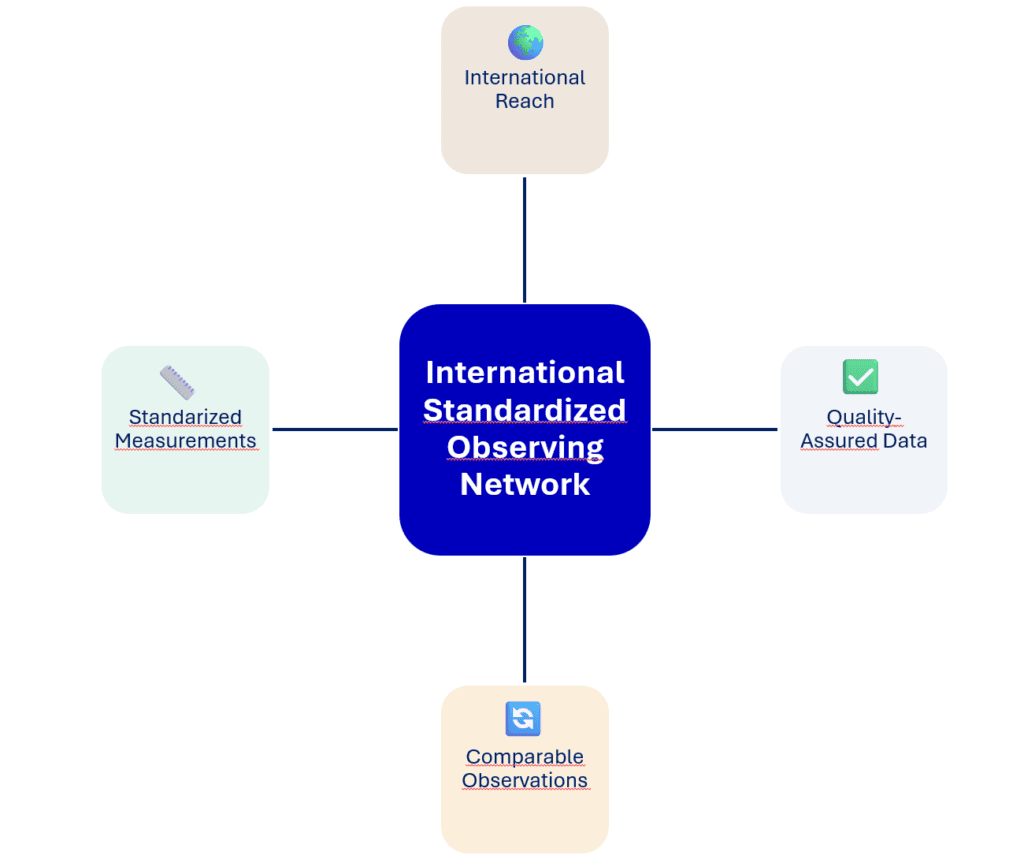
To better understand how observations from Ny-Ålesund contribute to international research, NySMAC has developed a working definition of an International Standardized Observing Network (ISON). These networks represent the highest level of coordination and standardization within the global observation system. Their strength lies in the ability to combine observations from many locations into consistent, high-quality datasets that support environmental monitoring, climate assessments, and scientific research worldwide.
Ny-Ålesund contributes to a remarkable number of these networks, reflecting both the quality of the observations collected at the station and the long-term commitment of the research institutions operating there.
International Standardized Observing Networks (ISON)
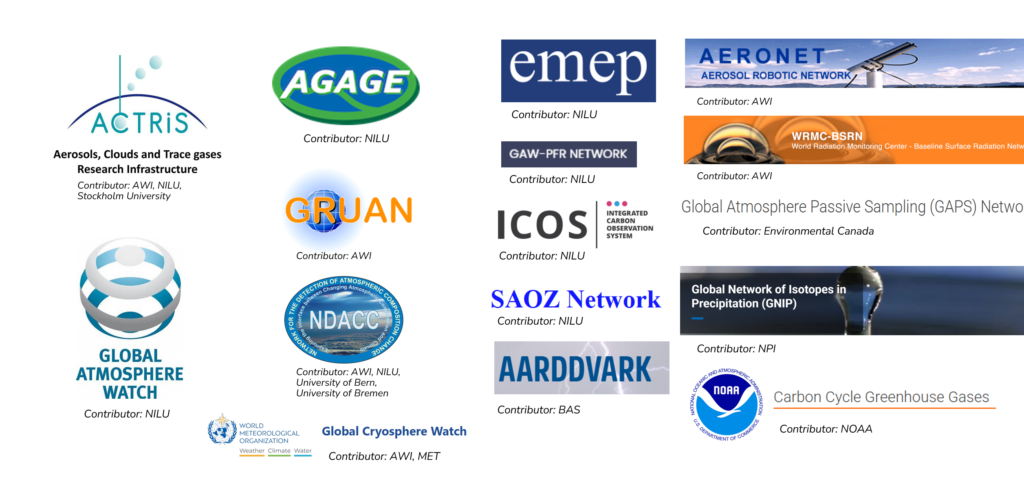
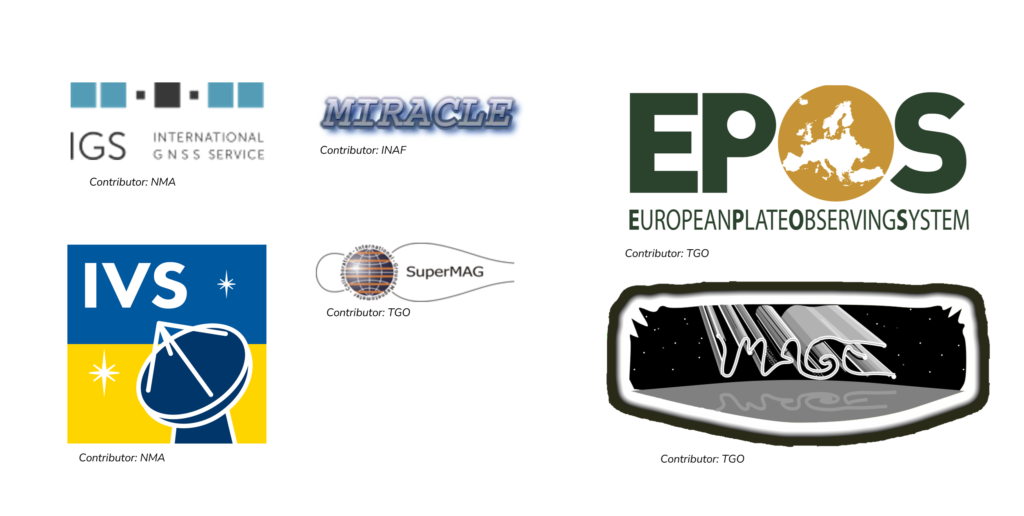
The Ny-Ålesund research community contributes data to approximately 30 International Standardized Observing Networks. These networks often have strict requirements regarding measurement protocols, calibration procedures, instrument performance, documentation, and data quality. The observations included in these networks originate from observatories, monitoring programmes, and research infrastructures operated by institutions working in Ny-Ålesund.
The networks represented below illustrate how observations from a single Arctic location become part of coordinated global efforts to understand the Earth system.
Other scientific networks and programmes
In addition to the ISON networks, observations and research activities in Ny-Ålesund contribute to around 20 other international networks, initiatives, and collaborative programmes. While these networks may not meet all the criteria used in the ISON definition, they remain important platforms for scientific cooperation, knowledge exchange, environmental monitoring, and data sharing. Some support regional observing activities, while others facilitate collaboration between researchers and institutions working on common scientific challenges.
The institutions behind the observations
The networks presented here are made possible by the institutions that operate scientific infrastructure, maintain long-term observations, and contribute data from Ny-Ålesund. They invest substantial effort in maintaining instruments and observing programmes at Ny-Ålesund Research Station. Their collective commitment ensures that observations can be sustained over decades and shared through international networks. The success of Ny-Ålesund as a global observing site is therefore the result of extensive collaboration among the many institutions that work at the station. In addition to the NySMAC institutions, these include Environmental Canada, Franche-Comté University, INAF, INGV, NOAA, Meteorological Institute in Norway, Tromsø Geophysical Observatory, University of Bergen, University of Bern, and University of Bremen.
International Standardized Observing Networks
- GAW Global Atmosphere Watch https://community.wmo.int/site/knowledge-hub/programmes-and-initiatives/global-atmosphere-watch-programme-gaw
- GAW-PFR Global Atmosphere Watch Precision Filter Radiometer https://www.pmodwrc.ch/en/world-radiation-center-2/worcc/gaw-pfr/
- BSRN Baseline Surface Radiation Network (BSRN) https://bsrn.awi.de/
- GRUAN Global Climate Observing System (GCOS) Reference Upper-Air Network https://www.gruan.org/
- GTN-P Global Terrestrial Network for Permafrost (GTN‐P https://gtnp.arcticportal.org/ WGMS World Glacier Monitoring Service. WGMS is a service of and GTN-G and GTN-H https://wgms.ch/ CryoNet Integrated CryoNet Cluster (as part of GCW)
- CryoNet Integrated CryoNet Cluster
- ACTRIS Aerosol, Clouds, and Trace Gases Research Infrastructure https://www.actris.eu/
- AERONET Aerosol Robotic Network https://aeronet.gsfc.nasa.gov/new_web/index.html
- AGAGE Advanced Global Atmospheric Gases Experiment https://www-air.larc.nasa.gov/missions/agage/
- AMAP AMAP https://www.amap.no/
- EMEP European Monitoring and Evaluation Programme
- GAPS Global Atmospheric Passive Sampling Network https://www.canada.ca/en/environment-climate-change/services/air-pollution/monitoring-networks-data/global-atmospheric-passive-sampling.html
- GNIP Global Network of Isotopes in Precipitation https://www.iaea.org/services/networks/gnip
- ICOS Integrated Carbon Observation System https://www.icos-cp.eu/
- IGETS International Geodynamis and Earth Tide Service http://igets.u-strasbg.fr/
- IGS Interational GNSS Service https://geodesy.science/item/igs/
- ITEX International Tundra Experiment (ITEX) https://www.gvsu.edu/itex/ IVS International
- VLBI Service https://ivscc.gsfc.nasa.gov/
- MIRACLE Magnetometers – Ionospheric Radars- Allsky Cameras Large Experiment https://space.fmi.fi/MIRACLE/
- NOAA/GML CCGG NOAA/GML CCGG cooperative air sampling network
- Carbon Cycle Greenhouse Gases – NOAA Global Monitoring Laboratory
- SAOZ System of Analysis by Zenithal Observation http://saoz.obs.uvsq.fr/
- USGS GSN GSN – Global Seismographic Network https://www.usgs.gov/programs/earthquake-hazards/gsn-global-seismographic-network
- AARDDVARK Antarctic-Arctic Radiation-belt dynamic deposition observed by the VLF Atmospheric Research Kartell https://space.physics.otago.ac.nz/aarddvark/
Other scientific networks
- AMAP https://www.amap.no/
- COAT Climate-ecological Observatory for Arctic Tundra https://data.coat.en/
- CRIOS Cryosphere Integrated Observation Network on Svalbard https://crios.pl/
- ECMWF European Center for Medium-Range Weather Forecasts https://www.ecmwf.int/
- ESB Norway The Environmental Specimen Bank – Norway https://miljoprovebanken.no/english/
- EUMETNET https://www.eumetnet.eu/
- INGOS Integrated non‑CO₂ Greenhouse gas Observing System https://www.icos-etc.eu/ingos
- MILKYS Environmental Contaminants in Coastal Areas https://www.miljodirektoratet.no/ansvarsomrader/overvaking-arealplanlegging/miljoovervaking/overvakingsprogrammer/forurensning-og-klimagasser/miljogifter-langs-kysten/ (webpage only in Norwegian)
- MOSAIC Mesospheric Ozon Spectral Analysis Instrument Chain
- MOSJ Environmental Monitoring of Svalbard and Jan Mayen https://mosj.no/en/
- SEAPOP SEAbird POPulations https://seapop.no/en/
- SIOS Svalbard Integrated Arctic Earth Observing System https://sios-svalbard.org/
- TTT Tundra Trait Team https://tundratraitteam.github.io/
- WOUDC Part of GAW. Global archive of ground-based ozone and UV radiation data https://woudc.org/data/explore.php?lang=en
Did you find what you were looking for?