Little Sea Ice in Kongsfjorden
This year’s sea‑ice research in Kongsfjorden on Svalbard confirms a clear trend of steadily decreasing ice. The researchers had to settle for making observations only in the very innermost parts of the fjord.
Original Norwegian text by Elin Vinje Jenssen / Norsk Polarinstitutt
https://npolar.no/nyhet/lite-havis-i-kongsfjorden-etter-mild-vinter/
Translated with Microsoft Copilot, checked and edited by Fieke Rader / Norsk Polarinstitutt
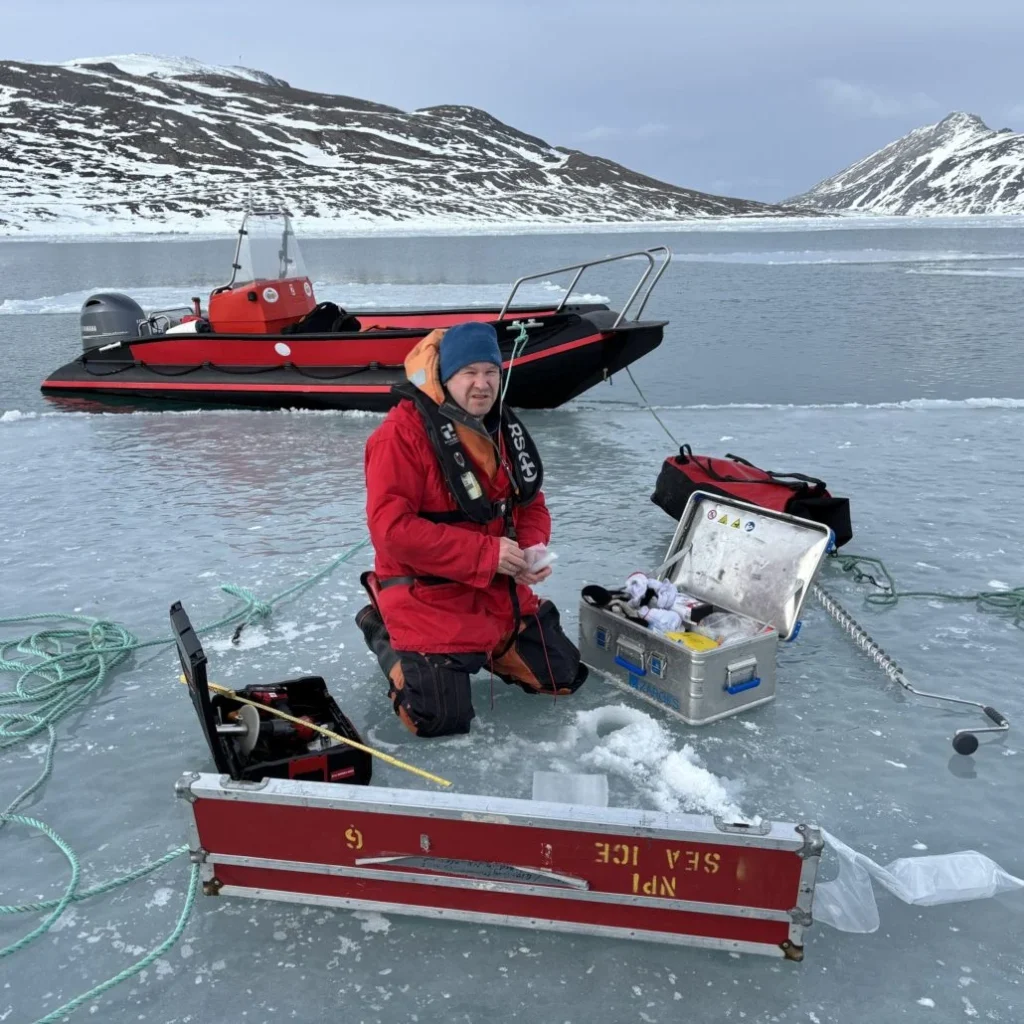
This year’s fieldwork for monitoring sea ice in Kongsfjorden near Ny‑Ålesund has now been completed. The investigations were carried out during a season with very little sea ice, limited to the innermost areas of the fjord. A recent warm spell, with temperatures above freezing and periods of rain, led to snow‑free and very slippery ice surfaces where ice still remained. Sea‑ice researcher Sebastian Gerland of the Norwegian Polar Institute, just returned from this year’s fieldwork in the fjord. He says:
“This year clearly falls into the category of very little sea ice in Kongsfjorden,”
The fieldwork included drilling to measure ice thickness and collecting ice cores. The samples will be analyzed to provide insight into the physical, chemical, and biological properties of the ice. Such measurements are important for understanding how climate change affects the fjord systems on Svalbard.
Natural variations vs. climate change
Kongsfjorden is an important research area because it lies at the transition between cold Arctic climate and warmer Atlantic water masses. Variations in the sea‑ice cover here therefore provide early indicators of climate change in the Arctic.
According to Gerland, years with little sea ice have become far more common than before.
“Even though we occasionally see years with more sea ice, it is now the years with little ice that dominate. This has increasingly become the new normal.”
During this year’s campaign, based at the Ny‑Ålesund research station, the researchers observed both sea‑ice floes and small icebergs in the innermost parts of the fjord. In Raudvika, at the very end of Kongsfjorden, there was still land‑fast ice, but even here the snow cover was largely gone or transformed into ice.
The results from this year’s fieldwork will be included in long‑term data series used to document developments in the Arctic over time. Such time series are essential for distinguishing between natural variations and long‑term climate change.
Did you find what you were looking for?