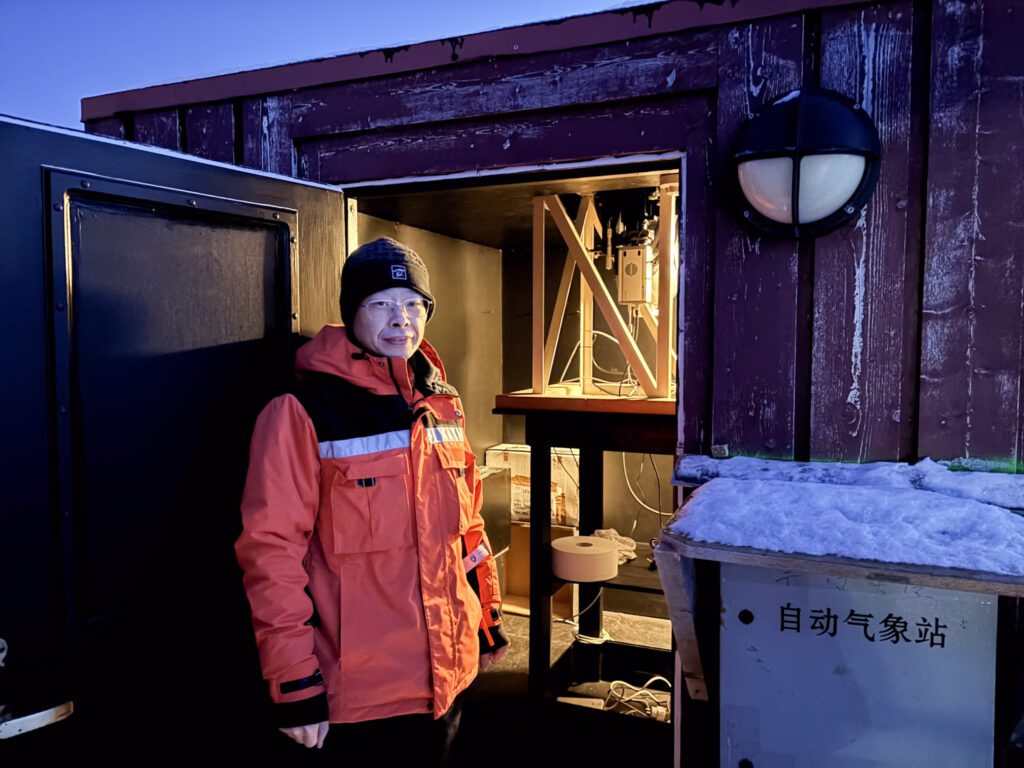
Scientists Dehong Huang and Peng Xiao in Ny-Ålesund.
The end of the auroral season
Scientist Dehong Huang and his colleague Peng Xiao have spent the entire dark season in Ny-Ålesund Research Station to study the aurora borealis. They arrived on the 24th of October 2025, the day the sun set behind the horizon, and used the polar night to perform their observations.
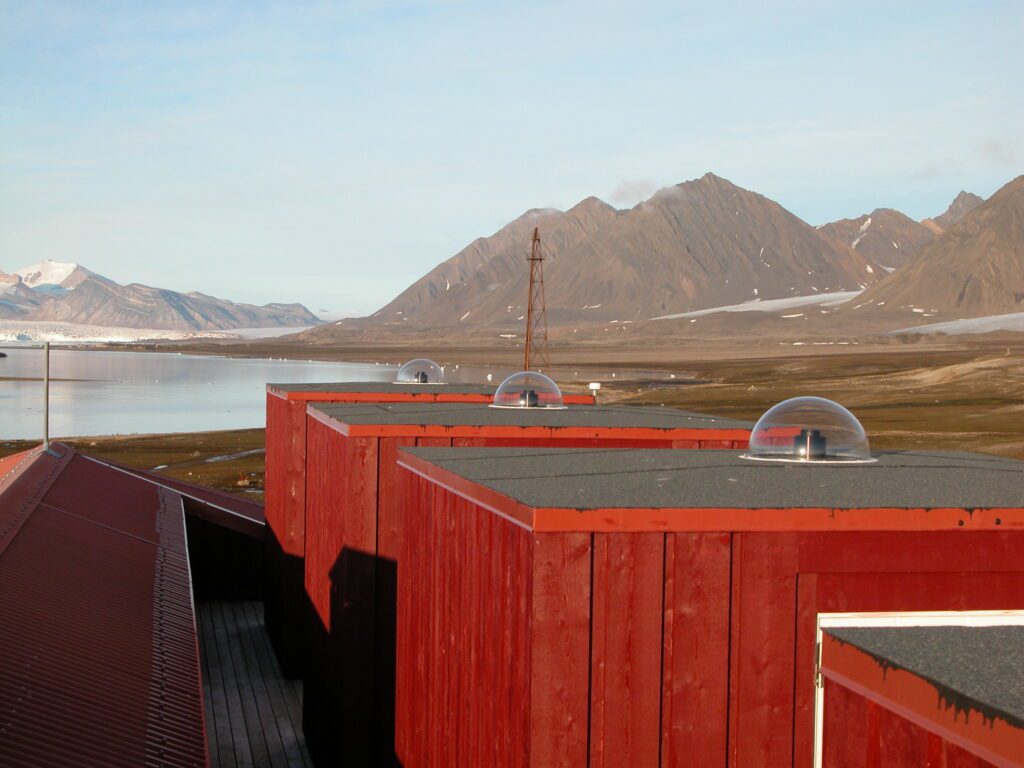
They looked at the auroras through three transparent glass domes, using imagers that capture light at 427.8 nm, 557.7 nm and 630.0 nm. Measuring auroral light requires “proper” darkness, in this case meaning that the sun is at 10° or more below the horizon. Ny-Ålesund Research Station is a fitting location for this type of research, as it has 49 days in which the sun is 24/7 below 10°, making it possible to measure not only at night, but during daytime too.
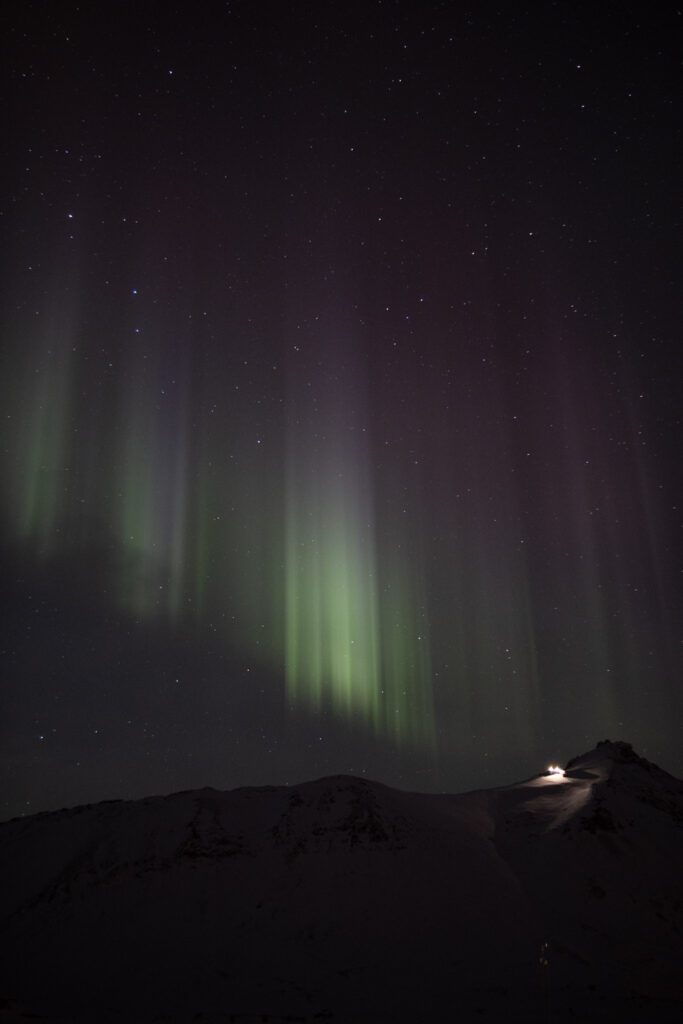
Not only do Huang and Xiao study the “normal” auroras, Ny-Ålesund is also a good spot to study so-called “cusp auroras”. The cusp is a region in the Earth’s magnetic field where the magnetic field lines come together and form a funnel-like shape. This allows solar wind particles to enter almost directly into the Earth’s atmosphere, bypassing the magnetic shielding. This results in cusp auroras: high energy, often red-colored auroras. As the polar cusp is above Svalbard around noon, one needs darkness 24/7 to observe this type of aurora.
Studying both normal and cusp auroras provides a way to understand and predict space weather and understand our upper atmosphere better. Knowledge on this helps to mitigate the effects on our technology in space (satellites and the connected communication systems), as well as improving atmospheric and climate models.
While we are happy to see the days getting brighter and lighter, yet we are sad to have said goodbye to Dehong and Peng. The seasonality of the light, the life and the scientists is strong in Ny-Ålesund. Thank you for your dedicated work this dark season!
Did you find what you were looking for?