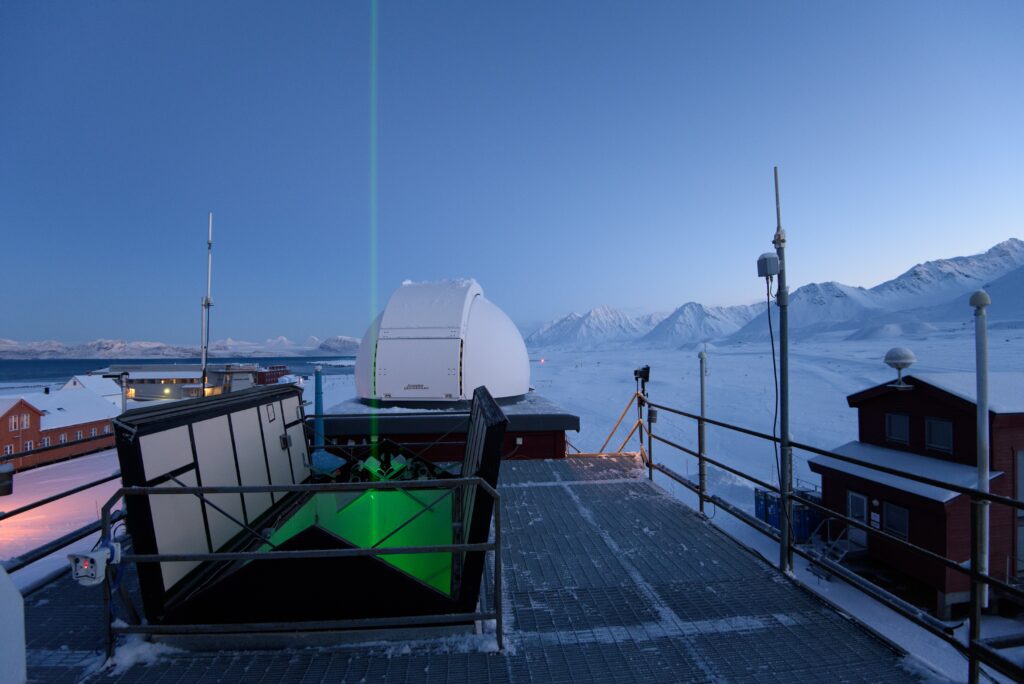
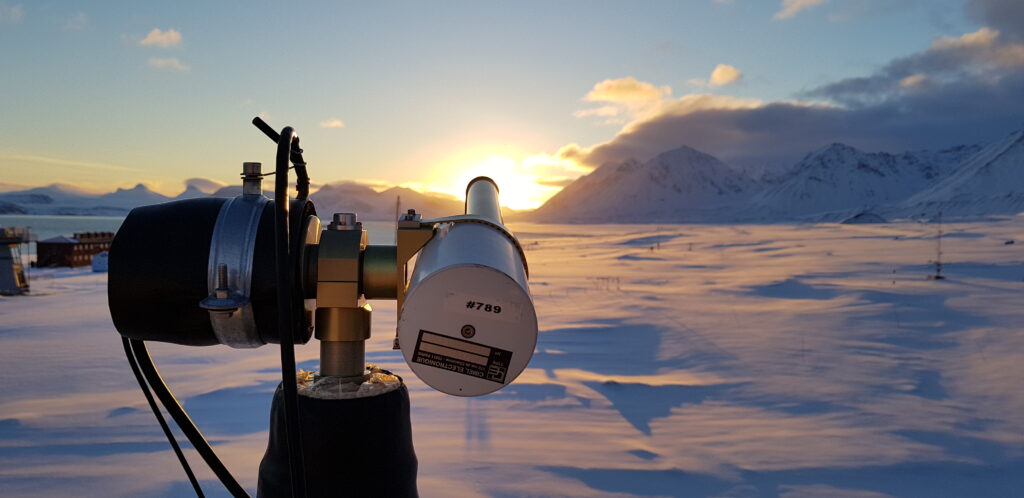
The CE318-T sun-sky-lunar photometer in Ny-Ålesund. Picture by Ramiro González Catón (GOA-UVa).
New publication – Exceptional high AOD over Svalbard in summer 2019: a multi-instrumental approach
Text by: Sara Herrero-Anta and Stefania Gilardoni
A new publication is out! “Exceptional high AOD over Svalbard in summer 2019: a multi-instrumental approach”, Herrero-Anta et al. (2026). https://acp.copernicus.org/articles/26/1435/2026/acp-26-1435-2026.pdf
In 2020, nine European research groups joined forces in the ReHearsol project (Re-evaluation and Homogenization of Aerosol Optical Depth Observations in Svalbard; Hansen et al., 2022). The goal was to collect, combine, and analyze observations of climate‑relevant aerosol properties across the Svalbard region.
The project produced a comprehensive dataset covering 2002–2020, which revealed unusually high aerosol optical depth (AOD) values during the summer of 2019. At the same time, at the start of the MOSAiC campaign in September 2019, researchers detected a distinct aerosol layer in the upper troposphere and lower stratosphere (UTLS) that showed clear signs of smoke.
A particularly active summer
The summer of 2019 was marked by an exceptionally intense fire season in the Northern Hemisphere, mainly due to large wildfires in North America and Siberia. At the same time, the Raikoke volcanic eruption (Kuril Islands, Russia) in June 2019 injected additional material into the atmosphere, increasing the background aerosol load in the UTLS.
Combination of multiple instruments and techniques
To identify the characteristics and the origin of the aerosol reaching Svalbard, all the available information in and around Svalbard was integrated and analyzed. This included in-situ measurements, sun-photometer data, lidar observations from both ground-based systems and satellites, as well as surface radiation observations. Finally, the FLEXPART dispersion model allowed the definition of aerosol trajectories reaching Ny-Ålesund.
What was found?
The results revealed that the aerosols in Svalbard in the summer of 2019 reached both the troposphere and the stratosphere. However, in-situ surface measurements did not reveal particularly extreme conditions compared to previous and following summers, indicating that much of the aerosol remained suspended at high elevations. Three main aerosol episodes were identified in the atmospheric column, linked to biomass-burning (BB) events in Siberia and North America and consistently detected by the different instruments. In addition, the FLEXPART simulation of SO2 emitted from the Raikoke volcano correlated well with an increase in AOD occurring between these BB episodes and the plume altitudes observed with the lidar.
Was it smoke or volcanic aerosol by the end of summer?
Whether the aerosols observed at such altitudes were ash or soot was under strong debate, with studies showing different results. The presence of an anticyclonic system in Siberia during summer 2019 likely enhanced the transport of BB aerosol to the Arctic, first northwards into the Arctic and then eastwards towards North America. In addition, some self-lofting during the BB episodes might have allowed these aerosols to reach the stratosphere. With all this, the contribution of the BB was likely more important than the volcano contribution in the UTLS.
Did you find what you were looking for?