The SARAS team from Raman Research Institute
Looking for the first stars and galaxies
Research at the Ny-Ålesund Research Station spans a wide range of natural sciences. Due to its remote setting and relatively low radio‑wavelength pollution, it turned out to be a good location for studying the first stars and galaxies formed after the Big Bang.
A team from the Raman Research Institute (RRI), facilitated by NCPOR, India, uses the SARAS telescope to perform precision low‑frequency radio observations. The telescope measures signals between 100 and 200 MHz, aiming to detect stars and galaxies far away in space. The biggest challenge lies in filtering out all other signals within the same wavelength spectrum. It is like trying to listen to one whispering person in a hall full of people shouting. This requires good engineering, instrumental set-up and data processing.
Because few people live in Ny-Ålesund and radio‑emitting devices are regulated, the background noise from the settlement itself is low enough to support this research. Sunlight is also a source of interference, but since no direct sunlight reaches the instrument, and the Sun is mostly below the horizon in February, Ny‑Ålesund was suitable for measurements both day and night.
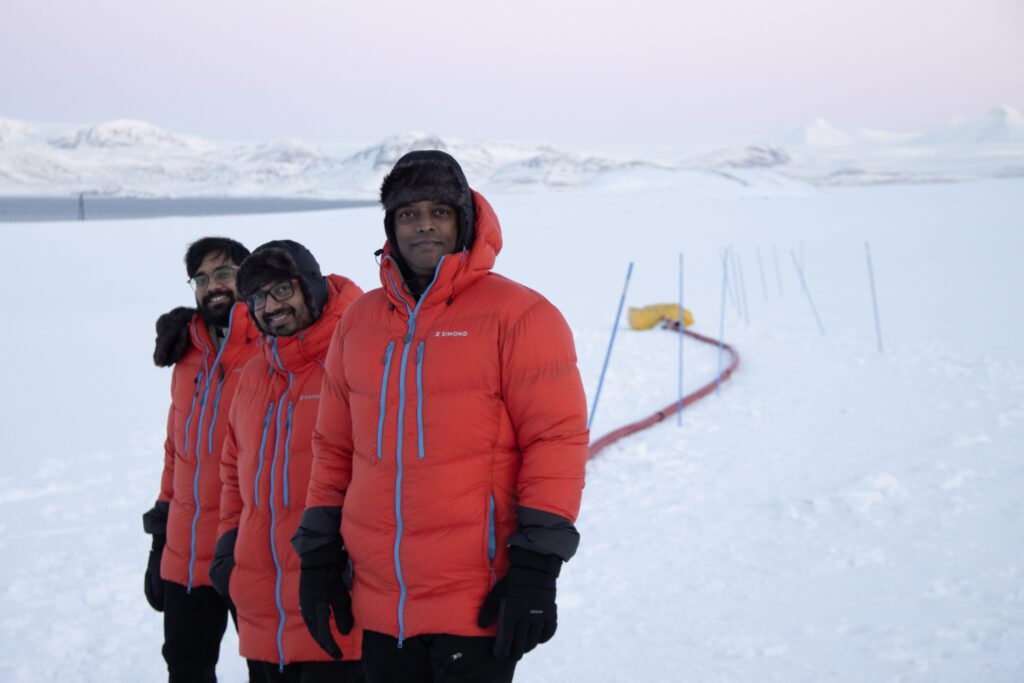
To precisely estimate instrumental features and wavelength contamination, data on geology, snowpack, and atmospheric composition are all relevant. A good understanding of the wavelength‑related properties of the surroundings makes telescope contamination calculations more accurate. Once again, it shows how different research disciplines depend on one another and how much science relies on collaboration.
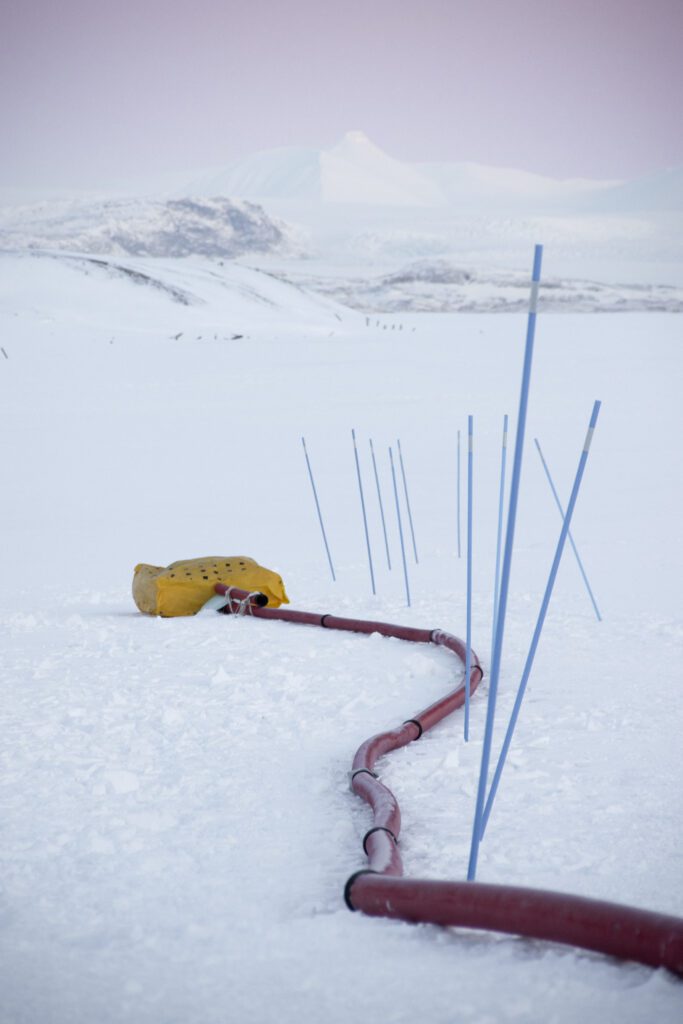
The telescope might not look like what you expect. It is a relatively small device that can be mounted and dismounted easily, making it possible to conduct measurements at several locations around the planet. In the picture, you see the telescope packed in a protective yellow bag, with all optical and power cables covered by a red tube. The tube had to be installed because the foxes did not respect the importance of ongoing science and chewed through the optical cable. Rude. Just when you think you’ve accounted for everything in your experimental setup, the Arctic finds a way to surprise you.
Did you find what you were looking for?