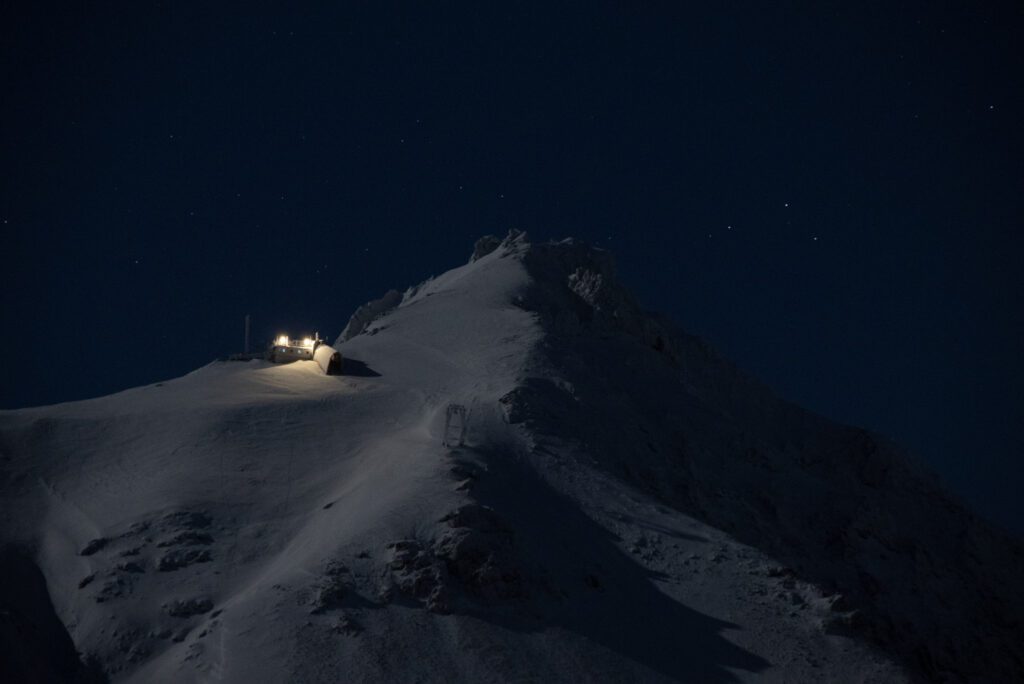
Zeppelin mountain. Picture by Fieke Rader, Norwegian Polar Institute.
Zeppelin PhD dissertation
In 2025, a PhD dissertation based on observations from Zeppelin observatory was defended by Dominic Heslin-Rees, affiliated to Stockholm University. All research performed during his PhD focused on several instruments and measurements on Zeppelin, to better understand trends and seasonality of Arctic atmospheric aerosols. This article will give some further insights on the performed research and its relevance.
Zeppelin observatory is the observatory at 474 m a.s.l., situated on the ridge of Zeppelinfjellet, run and owned by the Norwegian Polar Institute. At its foot lays Ny-Ålesund, and Zeppelin mountain is considered our “home mountain”. The observatory is located above the boundary layer, minimizing the effect of local pollution up in the air. This allows to do research on larger, global phenomena, and a strong focus is on research of (greenhouse) gases and aerosols. Several research institutions have their instruments installed in and on Zeppelin observatory, with NILU and Stockholm University as the main users.
All information from now on is extracted, reformulated and partly quoted from the PhD dissertation of Heslin-Rees.
Why study aerosols?
The Arctic is warming rapidly, with temperatures rising four times faster than the global average. Several factors play are role in the warming, including greenhouse gases and aerosols. Aerosols affect the radiative balance both directly (by reflecting / absorbing light), and indirectly (by influencing cloud formation, brightness and longevity, which then either reflects / absorbs light). The exact role and effect of aerosols on the radiative balance in the Arctic is still subject to insecurities and discussions. How do they affect cloud formation? How do they affect the radiation balance? How do aerosol type and concentration change over the seasons? Further research on aerosols in the Arctic is important to close this knowledge gap and to make climate models and predictions more reliable.
How study aerosols?
Heslin-Rees used different instruments and measurements to learn more about seasonal and long-term changes in aerosols and aerosol-related factors. He used data sets from instruments that measure:
- Light-absorbing particles by a filter-based absorption photometer and particle soot absorption photometer
- Cloud particles by a ground-based counterflow virtual impactor
- Concentrations and sizes of particles using a Differential Mobility Particle Sizer and Neutral cluster and air ion spectrometer
- The origin and trajectories of air masses by using the model HYSPLIT
Some key discovery points show…:
- …how “(…)the concentration of light-absorbing aerosol particles had declined over the past two decades.” The decline can be explained by an increase in precipitation (which flushes out aerosols from the sky) and a change in emission of aerosols.
- … how clouds can contribute to both the production and the removal of aerosols, mostly depending on the size of the aerosols.
- … how light absorbing particles (dark particles such as black carbon / soot) can be activated into cloud droplets.
- … how new particle formation can increase the concentration of particles that can form clouds. This particle production mostly occurs when the atmosphere is particularly clean, and affects the cloud formation potential.
All in all, the work of Heslin-Rees contributes to a better understanding of aerosols properties and its seasonal and long-term changes and in the larger scope, contributes to understanding the Arctic climate system better.
Congratulations on this achievement!
Did you find what you were looking for?