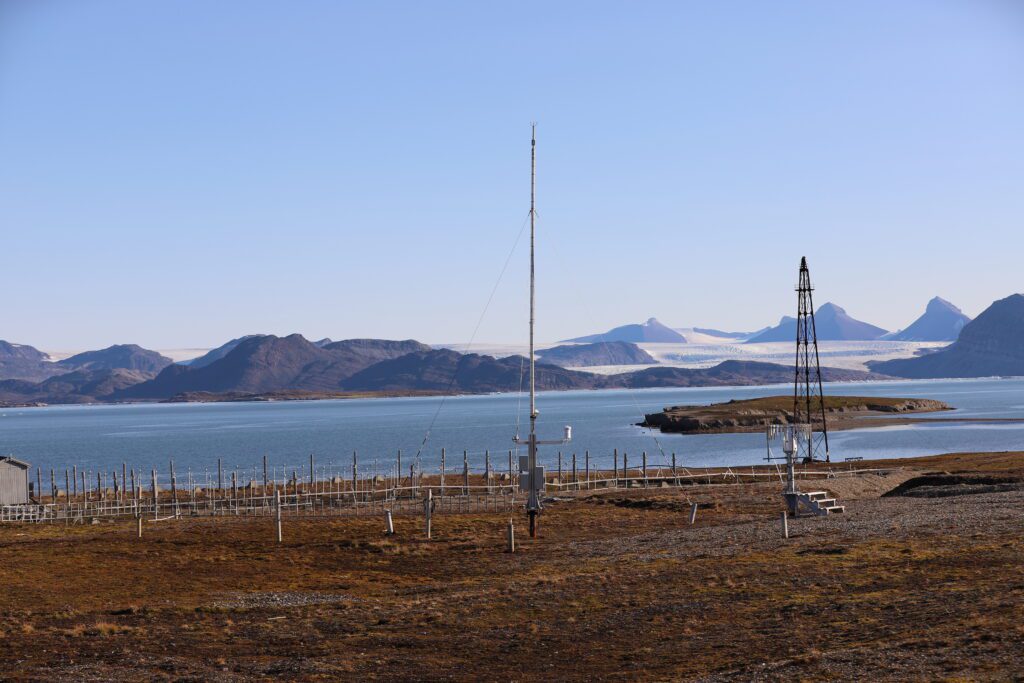
The automatic weather station in Ny-Ålesund in 2023. Picture by MET (Norwegian Meteorological Institute).
Ny-Ålesund Weather Station Helps Us Understand Climate Change in the Arctic – since 1969
Original text by Mai-Linn Finstad Svehagen (Norwegian Meteorological Institute), 26.11.2025
Translated with Microsoft Copilot, 03.12.2025
Checked and edited by Fieke Rader, 03.12.2025
Authors of the research report: Herdis Motrøen Gjelten & Mareile A. Wolff
The weather station from the Norwegian Meteorological Institute in Ny-Ålesund, Svalbard, provides valuable data on the rapid warming in the Arctic. Measurements since 1969 show that temperatures have risen and rainfall has increased. Such data are crucial for understanding how climate change affects one of the world’s most vulnerable regions. A new research report examines important supplementary data needed to interpret and use these measurements in Arctic climate research.
A Unique Dataset
The data series from the Ny-Ålesund weather station is one of the most downloaded and widely used datasets from the Norwegian Meteorological Institute. The station, established in 1950, has delivered regular measurements of temperature, precipitation, snow depth, wind, and humidity since 1969. It is operated in collaboration with the Norwegian Polar Institute and the Alfred Wegener Institute in Germany.
The data from Ny-Ålesund are freely available through the Meteorological Institute and shared globally via the World Meteorological Organization’s (WMO) Global Telecommunication System (GTS). The long dataset plays an important role in Arctic climate research, a region experiencing faster warming than the rest of the world.
To conduct reliable climate analyses, good metadata and quality information are essential.
Temperature measurements in Ny-Ålesund show significant warming since 1969. According to MET’s analyses, the average temperature has increased by 0.7 degrees per decade. The rise is especially pronounced in the winter months, with warming of about 1 degree per decade. In summer months, the increase is more moderate at 0.3 degrees per decade.
Studies have shown that recent decades have seen even faster warming. For example, data from 2001–2020 show an increase of 1.1 degrees per decade. This highlights the accelerating effect of climate change in the Arctic.
More Rain Instead of Snow
“Precipitation in Ny-Ålesund has increased by seven percent per decade, and more of it now falls as rain than before. The main driver behind these changes is the large temperature rise in the Arctic,” says climate researcher Herdis Motrøen Gjelten.
This change has a side effect. Rain is easier to measure than snow, simply because wind blows snow past the gauge, so it isn’t recorded. Heavier raindrops, however, are collected even on windy days. This can lead to annual precipitation appearing to increase, even if only rain is measured. And if snow is added, the total rises even more.
To distinguish precipitation increases caused by climate change from those caused by measurement uncertainties between rain and snow, researchers need information about instruments, measurement methods, and data quality.
Such information is now available in the new report.
An Invaluable Resource for Climate Research
The Ny-Ålesund weather station has undergone several upgrades and relocations since its establishment more than 70 years ago. From manual measurements to modern automatic weather stations, the station has continuously evolved. These changes provide more frequent updates and more accurate data.
“Information about these changes was previously only logged in internal reports and was not as easily accessible as the dataset itself. With this report, the data are now published and can be used by anyone working with the weather station’s data in their research,” explains researcher Mareile Astrid Wolff.
The data series from the station is an important resource for climate researchers seeking to understand Arctic climate change. The Meteorological Institute has also facilitated easy global access to these data through open platforms such as seKlima and Frost, enabling researchers worldwide to analyze the Arctic climate.
Contact the researchers

Mareile Astrid Wolff Herdis Motrøen Gjelten
Did you find what you were looking for?